
The Philippine automotive market is not moving toward electrification — it is already in the middle of it. That is the clear-eyed assessment of Emmanuel San Luis, General Manager for Marketing at Nissan Philippines, who sat down with Global Dominion Financing, Inc. (@gdfiofficial on TikTok) for a candid look at where the country’s car industry is heading, how Nissan is positioning itself for the transition, and why the Philippines, for all its unique market characteristics, cannot afford to stand still.
The conversation is precise, grounded in data, and notably free of the hedging language that often surrounds EV discussions in markets still finding their footing. San Luis speaks like someone who has read the numbers and has already made his decisions — and the picture he paints is one of an industry in genuine motion.
A Very Rapid Shift in Preference
The opening line of the interview sets the tone for everything that follows. “We are seeing a very rapid shift in preference,” San Luis said — and the emphasis on the word “rapid” was deliberate. This is not the gradual drift of a market slowly warming to an idea. It is a measurable, accelerating change in what Filipino car buyers want, and what they are willing to walk away from.
The reference point he anchors this observation to is telling: way back 2024. The framing is instructive. In the span of just a few years, the landscape has changed enough that 2024 already reads like a different era in Philippine automotive preference. What drove that shift, in his telling, is a convergence of forces — the oil crisis and escalating fuel costs among them — that made the cost calculus of internal combustion ownership suddenly less comfortable for a broad segment of buyers.
The shift away from diesel or gas is not ideological, in other words. It is economical.
The Philippine Market’s Particular Rhythm
One of the more nuanced observations in the interview is San Luis’s acknowledgment that the Philippines operates on its own timeline. “Filipinos are quite unique,” he says, distinguishing the local market from the broader global automotive narrative. The country’s automotive markets, he notes, are probably always the last to change in the neighborhood — but that lag is narrowing.
This is an important distinction. The Philippine market has historically tracked global trends at a delay, insulated by a combination of infrastructure constraints, import dynamics, and consumer conservatism around new technology. The default buying behavior has long favored what is known, serviceable, and affordable to maintain — which is precisely why Japanese internal combustion engine (ICE) brands have held such commanding market share for decades.
But that conservatism is not the same as resistance. And the shift San Luis is describing suggests that once Filipino buyers begin moving, they move with conviction.
ICE Loyalty Meets EV Reality
The interview doesn’t romanticize the transition. San Luis acknowledges the reality squarely: there are customers who are really loyal to ICE engines — people who would like to stay with a conventional internal combustion vehicle, whether diesel or gasoline. That loyalty is real, it is earned over decades of reliable ownership experience, and it does not simply evaporate because a new technology arrives.
But the market is bifurcating. Alongside the ICE loyalists, a growing segment of buyers is actively seeking alternatives — and that segment is what Nissan, and the broader industry, is now building for in earnest.
The strategic implication is that carmakers operating in the Philippines cannot simply hold one position. They need to serve both populations simultaneously, which requires a product strategy that is genuinely multi-modal rather than a simple pivot from one powertrain to another.
Nissan’s Answer: PHEV to BEV to E-Power
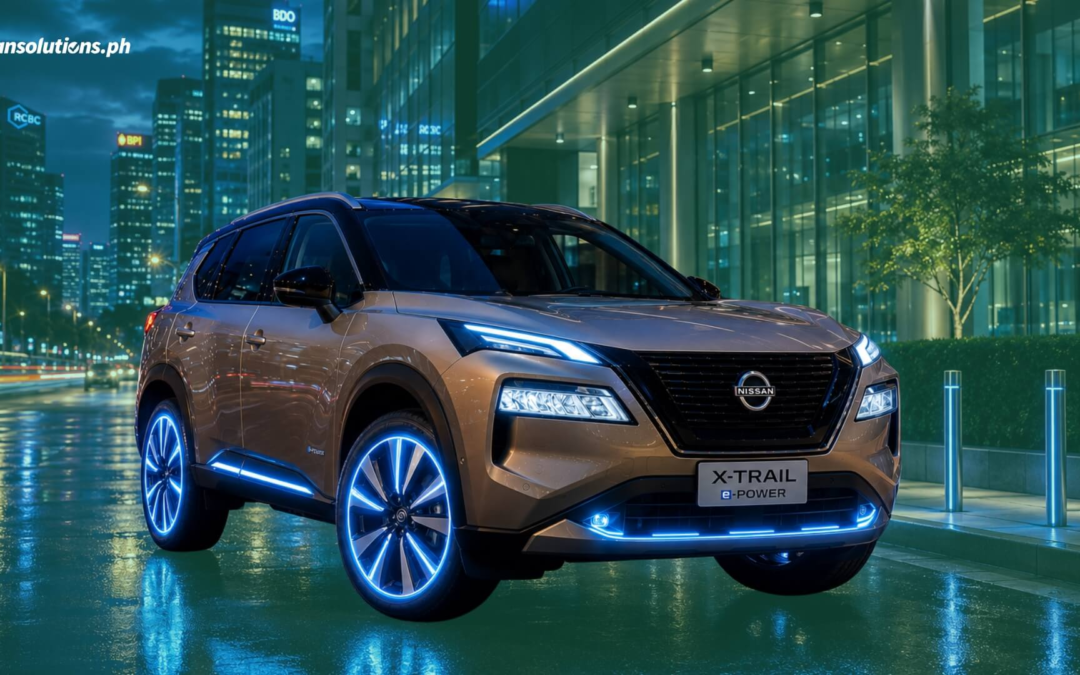
Nissan’s response to this bifurcation is a product lineup that San Luis describes as spanning from PHEV to BEV to E-Power — a full-spectrum electrification strategy rather than a single-bet approach. This is significant because it reflects a theory of the market that treats the transition as a gradient rather than a binary switch.
PHEVs (plug-in hybrids) serve buyers who want lower running costs but still carry range anxiety or lack home charging infrastructure. BEVs (battery electric vehicles) serve the fully committed early adopter segment. And E-Power — Nissan’s proprietary system in which an electric motor drives the wheels while a petrol engine acts as a generator — offers a bridge for buyers who want the feel and efficiency of electric driving without the charging dependency.
Together, the range is designed to meet the market where it actually is, not where manufacturers might wish it to be. “We’re going to introduce what the market wants at this point,” San Luis said — a statement that sounds obvious but is, in practice, difficult to execute across a product portfolio spanning multiple price points and use cases.
The SUV Segment Remains Central
Despite the electrification conversation, San Luis is clear-eyed about what still drives volume in the Philippine market: the SUV segment. “Still the SUV segment,” he confirms without hesitation, “Filipinos love that design,” — a shorthand acknowledgment that the SUV’s dominance in Philippine buyer preference has not been disrupted by the EV shift. If anything, the electrification of the SUV segment — through products like electrified crossovers and SUVs — is where the real battleground lies.
This is commercially significant for financing institutions like Global Dominion Financing as well. The vehicle loan portfolios that power Global Dominion’s business are overwhelmingly vehicle-use loans, and the SUV’s enduring dominance means that the transition to electrified models will not upend the fundamental demand for vehicle financing — it will simply change the products being financed.
Adapting Continuously — and the ASEAN Context
Perhaps the most strategically sober moment in the interview comes when San Luis describes Nissan’s posture toward the market as one of continuous evaluation and adaptation. “We continue to evaluate and adapt to the market,” he says — a stance that implicitly acknowledges that no one, not even a global automotive brand with deep market history, can lock in a fixed strategy for a transition that is still unfolding.
He contextualizes this within the ASEAN region. “We are always the last to adapt,” he notes — pointing to the shared dynamics of Southeast Asian markets as a frame for understanding the Philippine situation. The Philippines is not an island in this conversation. It is part of a regional ecosystem of automotive adoption, infrastructure development, and policy alignment that will shape how quickly and deeply electrification takes hold.
The dealer network, he adds, is also a central piece of this — a reminder that the infrastructure of automotive distribution, servicing, and customer experience is as critical to EV adoption as the vehicles themselves. A market can have willing buyers and compelling products, but without a prepared dealer network, the transaction chain breaks down.
What This Means for the Road Ahead
Emmanuel San Luis’s assessment of the Philippine automotive landscape is, at its core, a story about calibrated urgency. The shift is real and rapid. The market has its own rhythm. The products need to span the full spectrum of buyer readiness. And the organization — from manufacturer to dealer to financing partner — needs to keep moving and adapting.
For Global Dominion Financing, whose vehicle loan portfolio sits at the heart of this transition, the implications are concrete. The vehicles being financed are changing. The buyers asking for loans are changing. And the institutional partners — the Nissans and the carmakers of the Philippines — are already building for a market that looks quite different from the one that existed just a few years ago.
The rapid shift in preference that San Luis describes is not something that is coming. It is already here.
This article is based on an interview featured on the Global Dominion Financing, Inc. TikTok page (@gdfiofficial) hosted by Aian Guanzon. The views and opinions expressed by the interviewee are his own and do not necessarily reflect those of Global Dominion Financing, Inc. or Nissan Philippines.